Glass imagery and fragility
The Glass MenagerieGlass is both a cherished collection and a governing image in The Glass Menagerie: beautiful, delicate, and exposed to forces that care alone cannot prevent. The motif connects Laura Wingfield’s disability and social isolation to the play’s stagecraft, then becomes a small, concrete drama when Jim O’Connor accidentally breaks the horn of her unicorn. Its force lies in the tension between Laura’s vulnerability and her capacity to respond to damage with humor and imagination.
Image and Stage Language
The play’s introductory note makes fragility a principle of its theatrical design. The recurring tune named for the menagerie should carry two ideas at once: the beauty of delicately spun glass and how easily it can break. It moves in and out of the action, connecting Tom Wingfield, the narrator situated at a separate point in time and space, with the story he recounts. Returning between episodes, the music gives audible form to nostalgia, the play’s first condition, and comes through most clearly when attention settles on Laura and the glass that serves as her image.
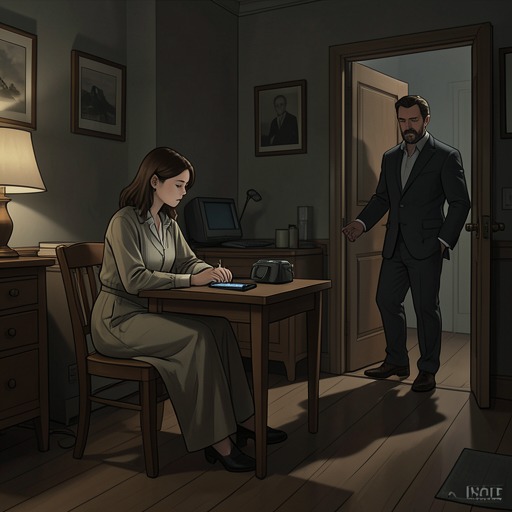
That image is not confined to dialogue or music. In Scene Two, Laura washes and polishes her glass ornaments before Amanda Wingfield comes home. Hearing her mother approach, Laura catches her breath, pushes the bowl of ornaments away, and sits stiffly at the typewriter keyboard diagram, as if absorbed in it. The shift from tending fragile objects to performing an appearance of ordinary study links the collection to a private refuge that must be hidden. The stage directions make the glass part of Laura’s immediate, physical life, not simply an emblem supplied by other characters.
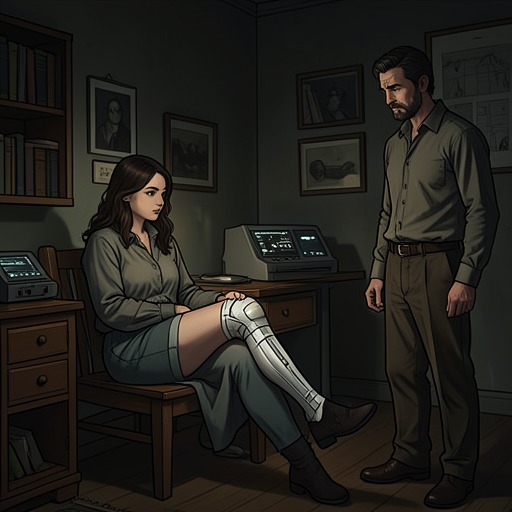
The play’s account of Laura’s condition also makes the comparison explicit. A childhood illness left one of her legs shorter and held in a brace; as her separation from other people grows, she is likened to a piece of her collection, too fragile to move from the shelf. The image illuminates her increasing withdrawal, but it also risks making bodily difference serve as shorthand for delicacy. The dramatic evidence complicates that reduction by showing specific effects: the brace clumps as she climbs stairs, and Laura remembers the sound as thunder, even though Jim says he never heard it.
Disability, Shame, and the World Outside
Laura’s leg affects how she moves through spaces and approaches other people. She recalls attending classes on Mondays, Wednesdays, and Fridays, arriving late because it was difficult to get upstairs. The brace’s noise made her dread entering class; Jim’s recollection that he never noticed the clumping sharply contrasts with the overwhelming sound Laura experienced. His later judgment that imagination magnified a barely noticeable defect offers reassurance, but it does not erase the fact that the stairs were hard for her to climb or that the embarrassment shaped her education.
Her withdrawal from business college is similarly bound to bodily distress and concealment. Laura tells Amanda that she could not return after vomiting on the floor. Rather than tell her mother the truth, she spent the day walking in the park and going inside places to get warm, allowing Amanda to believe she was still attending Rubicam’s Business College. Her confession, that she is crippled, meets Amanda’s emphatic rejection of the word: Amanda calls it a slight defect and advises her to compensate through charm and vivacity. Their exchange exposes a gap between Laura’s naming of her condition and her mother’s attempt to recast it as something negligible and improvable.
The glass image can therefore sharpen sympathy for Laura while also revealing the limits of a purely symbolic reading. Her experience is not only an abstract resemblance to a breakable object: it includes a brace, difficult stairs, a painful episode at school, and the decision to hide her absence. The play’s image of the collection as too delicate to move captures the pattern of separation, but Laura remains more than the image. She speaks about her body, manages her objects, and makes choices within the restricted circumstances the play presents.
The Collection and the Unicorn
When Jim asks what Laura means by her glass collection, she explains that it consists mostly of ornaments, little animals, and offers him one of the oldest, nearly thirteen years old. As she gives it to him, she warns, “Oh, be careful — if you breathe, it breaks!” Jim hesitates because he is clumsy, but Laura trusts him with the figure and guides him to hold it gently over the light. The exchange turns the handling of glass into a scene of intimacy: Laura determines how the fragile object should be treated and invites Jim to see the light shining through it.
That moment of trust is followed by an accident. While Laura and Jim are together, they bump into the table, and a piece falls to the floor. Jim stops, asks whether it is broken, and Laura stoops to pick it up. The unicorn has lost its horn; Laura says it is now like all the other horses. The object’s difference has been removed, but the break does not destroy it. Her remark that the change may be a blessing in disguise transforms the accident into a playful account of belonging among ordinary horses.
Laura extends that response rather than treating the damage as an unforgivable injury. She tells Jim that glass breaks easily despite care and that traffic jars shelves, sending things to the floor. Then she imagines that the unicorn had an operation to remove its horn so it would feel less freakish. They both laugh. In this exchange, the glass’s fragility remains real, but Laura supplies a comic interpretation of the broken piece that neither denies its loss nor leaves it defined by damage.
Meaning and Dramatic Consequence
The unicorn’s broken horn brings the motif’s central tensions into one visible change. Before the fall, the unicorn is distinctive among the horses; afterward, Laura imagines it as less freakish and more at home. The scene echoes the conflict already present in Amanda’s insistence that Laura should not call herself crippled and in Jim’s claim that her physical defect is hardly noticeable. But Laura’s joke is her own: rather than simply accepting another person’s judgment, she gives the altered object a story that makes its difference easier to inhabit.
The recurring music frames the glass as beautiful and vulnerable, while the action tests what that framing can and cannot say. Fragility helps express Laura’s isolation and the tenderness of her attention to the collection, yet the play also gives her a concrete history of movement, embarrassment, and concealment. The glass is subject to accidents beyond anyone’s careful handling; its breakage does not end its meaning. In Laura’s hands, the damaged unicorn becomes at once a reminder of vulnerability and an occasion for imagination, laughter, and a brief sense of kinship with the other horses.